Controlled Scope
Approved systems, databases, sources and permissions define the deployment boundary: what CIRMS can access and which operations it is authorized to perform.


From a single HERCULES deployment to hierarchical HERCULES–ATLAS and planned multi-ATLAS models for large-scale environments.
Select a deployment model to explore the relationship between managed resources, HERCULES and ATLAS.
A single HERCULES deployment provides centralized operational control for one managed environment through a hub-and-spoke communication model. It connects databases, applications, infrastructure, services and other operational resources to one execution layer.
Through GL3, HERCULES performs Intelligent Automation, monitoring, health checks, resource management and data acquisition. Through GL4, it transforms collected operational data into governed, structured and AI-ready knowledge.
The hub-and-spoke model uses standardized interaction patterns, simplifying administration and allowing additional resources and systems to be integrated as requirements grow without changing the underlying CIRMS architecture.
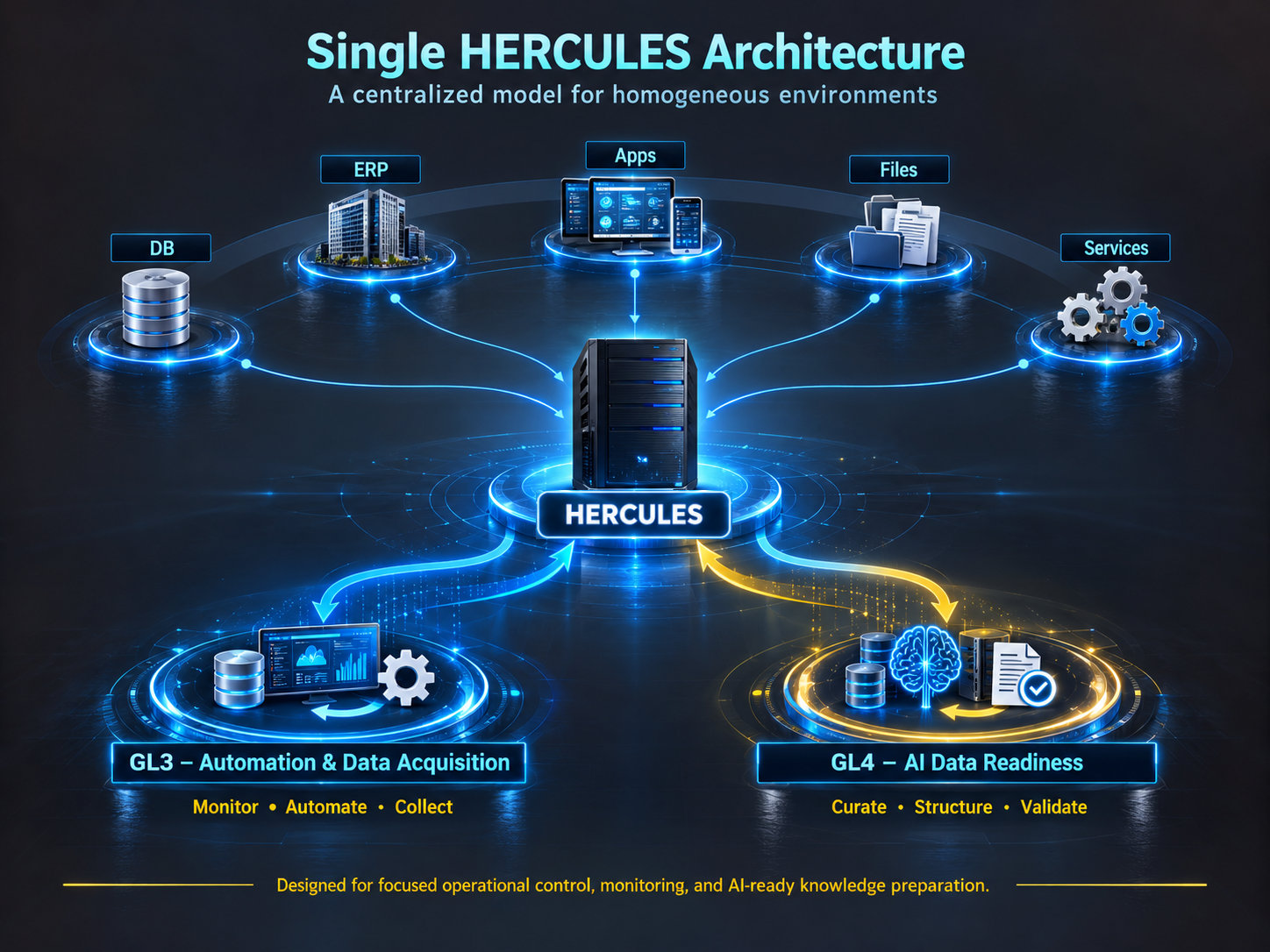
Simplified page schematic for the same deployment model.
This architecture introduces ATLAS as the centralized coordination and oversight layer above multiple HERCULES machines operating across different environments, sites or technology domains.
Each HERCULES continues to execute locally and independently, performing GL3 Intelligent Automation and Data Acquisition together with GL4 AI Data Readiness. ATLAS consolidates operational information from those environments and provides an organization-wide view for centralized monitoring, coordination and governance.
The hierarchical model supports distributed execution with centralized oversight and informed decision support. The planned GL5 evolution is intended to extend these capabilities with AI models, intelligent analysis and conversational intelligence while maintaining human oversight.
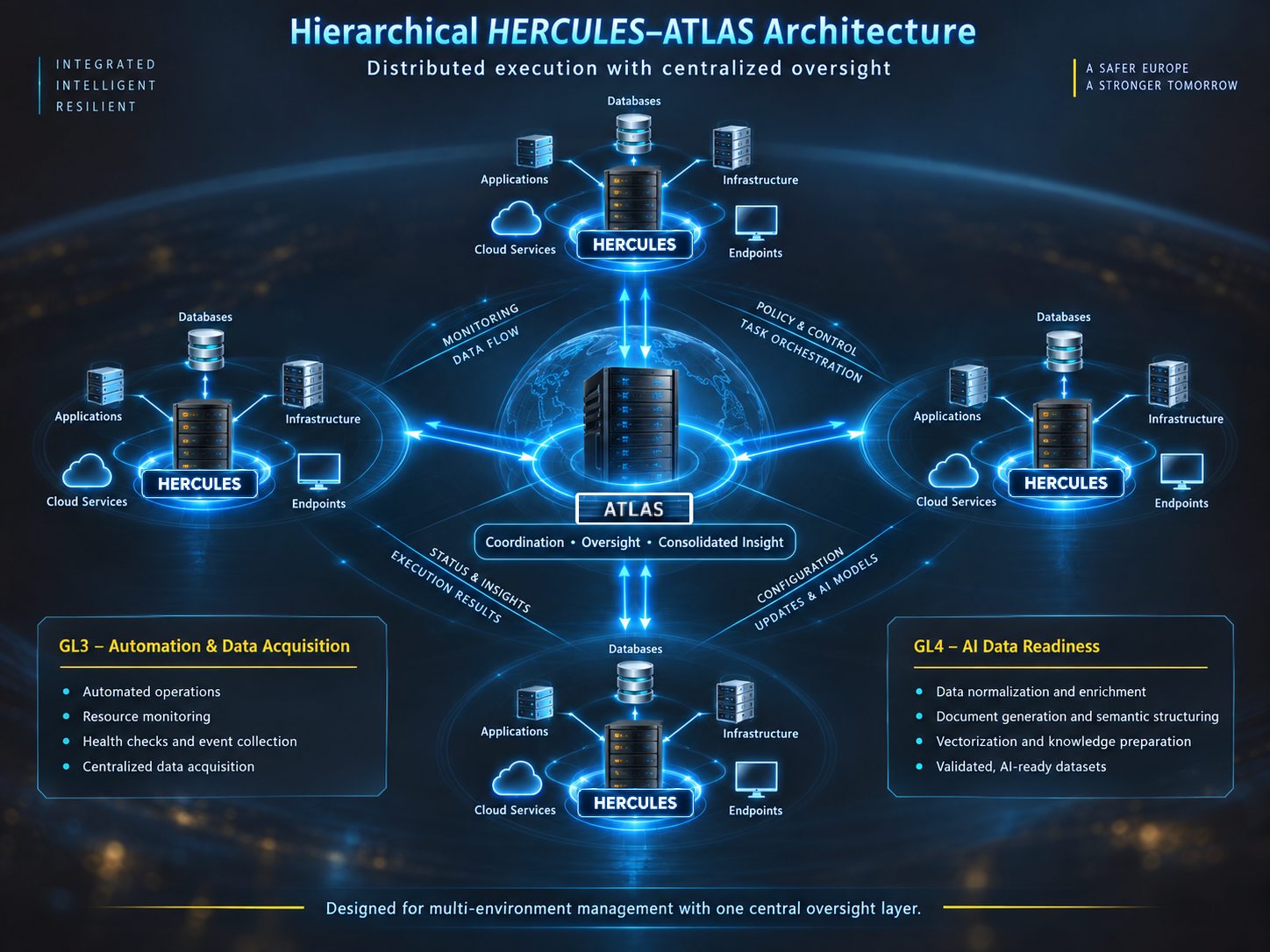
Simplified page schematic for the hierarchical model.
For large-scale, geographically distributed or multi-domain organizations, the planned CIRMS architecture can extend to multiple interconnected ATLAS machines, each coordinating groups of HERCULES environments.
This model is intended to support distributed oversight, operational resilience, scalability and organization-wide resource management while preserving local HERCULES execution. Proposed architectural goals include redundant supervision, coordinated continuity mechanisms and continuous operational visibility across multiple domains.
Future GL5 integration is intended to extend the architecture with AI models, intelligent analysis and decision support while maintaining centralized governance, traceability and human oversight.
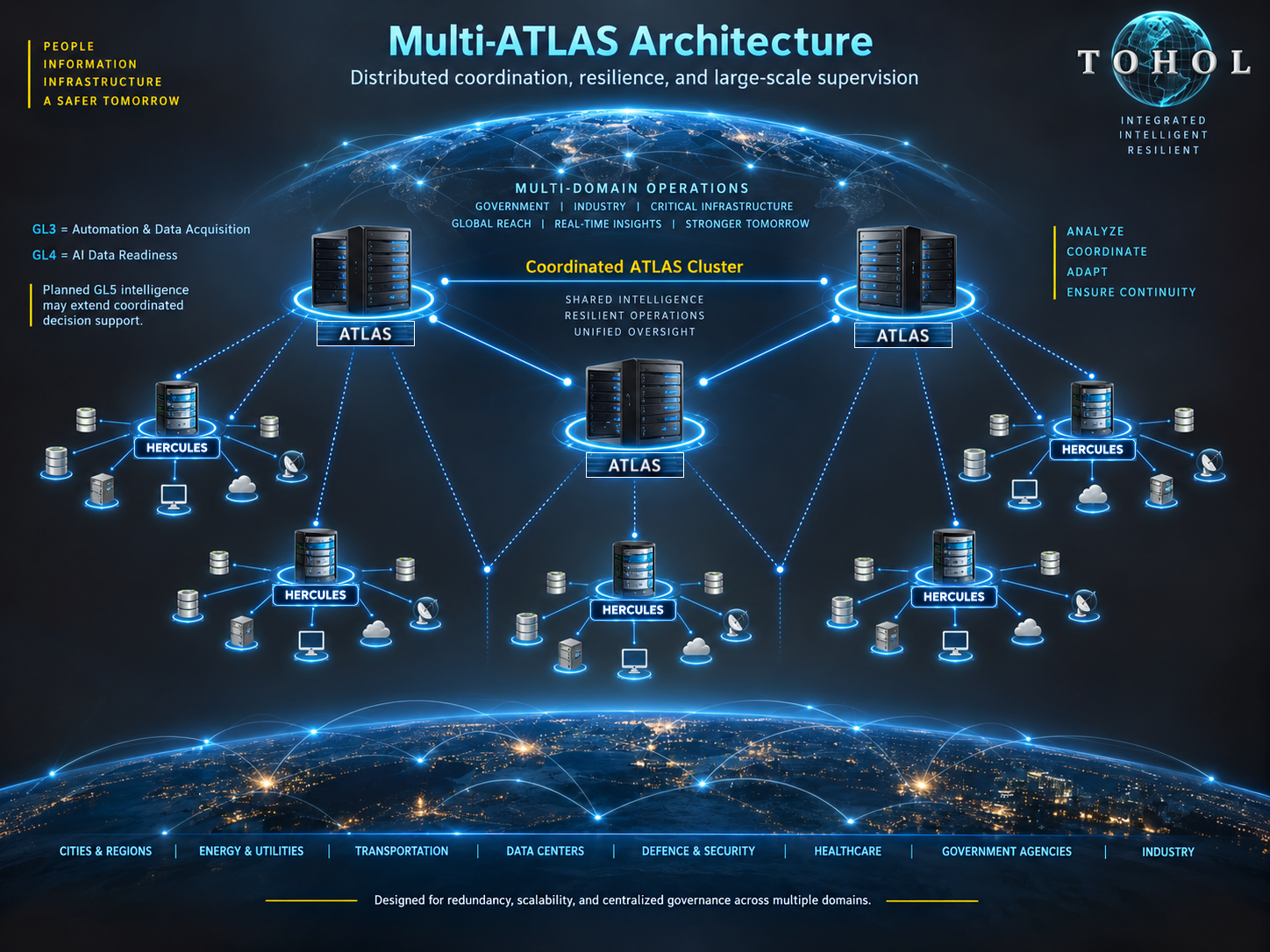
Simplified page schematic for the planned multi-ATLAS model.
Planned model: distributed oversight and redundant supervision are architecture goals.
CIRMS is designed to operate close to the environments it manages. Each deployment defines the systems, data sources, permissions and operational boundaries available to HERCULES and ATLAS. External services and AI integrations are introduced only within the agreed deployment scope.
Approved systems, databases, sources and permissions define the deployment boundary: what CIRMS can access and which operations it is authorized to perform.
HERCULES operates within or close to the managed environment, while ATLAS provides higher-level coordination where included in the deployment.
GL4 exposes registration, acquisition, preparation, validation, readiness and health status, so teams can inspect how operational data becomes prepared knowledge.
Automation and future AI-assisted actions remain subject to organizational controls, authorization and responsibility. People define the scope and review the outcomes.
External processing is a deployment decision. Any external service or AI provider must be assessed for the information it may receive, its access permissions and the agreed processing arrangements. Data movement is defined per deployment, not assumed from an architecture diagram.
Discuss deployment scopeGL3 automation and data acquisition, GL4 AI Data Readiness, healthchecks, monitoring, reports and dashboards.
Governance, coordination and an organization-wide view across HERCULES machines.
Future integration is intended to extend the architecture with AI models, intelligent analysis and conversational intelligence while maintaining governance and human oversight.
Discuss your environment, operational requirements and AI Data Readiness with Project TOHOL®.