
Repeatable Automation for Reliable Operations
Use the CIRMS operational foundation to organize repeatable administration, monitoring and health checks, with clear scope and accountable execution.
An additional application scenario based on the CIRMS operational architecture. Scope and supported integrations need to be confirmed.
Standardize the task. Make the result visible.
Repeated manual work can be difficult to carry out consistently across changing environments. This additional use case connects CIRMS's modular automation approach with operational visibility, without implying that AI is needed for every task.
Information in scope
- Managed resources
- The configured databases, infrastructure and connected systems.
- Operational tasks
- Repeatable administrative procedures with an agreed scope.
- Health definitions
- Checks and thresholds relevant to the selected services.
- Execution context
- Schedules, ownership and reporting requirements.
How the workflow is organized.
An application-level outline, not a claim that every source, connector or operational procedure is preconfigured.
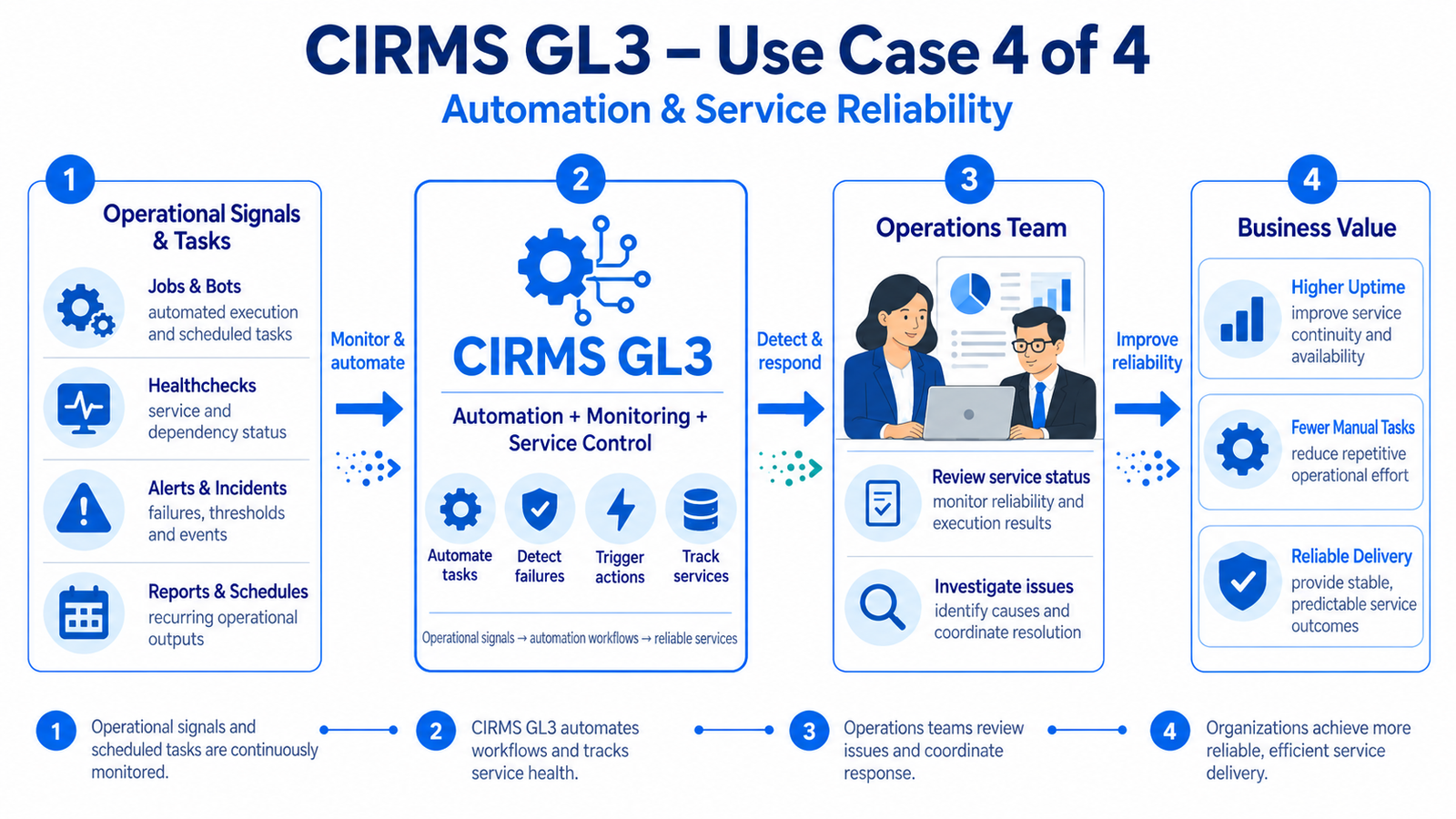
- 01
Define the task
Identify the operational objective, supported scope and responsible owner.
- 02
Compose the workflow
Use the CIRMS ATOMS and modules concept for repeatable operational work.
- 03
Execute and observe
Run configured GL3 tasks and review health checks, dashboards and reports.
- 04
Review exceptions
Investigate failures and refine the procedure before expanding its scope.
Repeatable operations
Aim for more consistent execution of agreed procedures.
Visible results
Give teams a basis for reviewing operational activity and exceptions.
Less repetitive work
Focus automation on clearly scoped tasks rather than uncontrolled autonomy.
The operational reliability workflow.
What sits behind the use case.
Separate the platform foundation from planned intelligence and the requirements of the target environment.
GL3 / GL4 & architecture
GL3 provides automation, monitoring, health checks, reporting and operational acquisition. HERCULES carries out the configured activities in its managed environment.
AI & future extensions
GL4 can prepare selected operational information for later AI use. GL5-generated recommendations or self-directed remediation are not required by, or claimed for, this base workflow.
People, data & permissions
Define permissions, schedules, preconditions, verification and recovery procedures. Operational owners should approve changes to the automation scope and review exceptions.
A bounded evaluation
Select one recurring procedure and a representative environment. Validate the workflow and its failure handling with the team responsible for the resource.
Candidate measures: successful task completion, failed runs, manual interventions, coverage of scheduled checks and time spent on the selected procedure.